Activated carbon is a porous material with a large internal surface area and exceptional adsorption capacity. This property makes it widely used in various industries, such as water and air purification, the pharmaceutical industry, and the energy sector.
However, its distinctive feature is its manufacturing process . The quality of activated carbon, its specific surface area, its pore distribution, and even its end use depend on the type of raw material and the activation process. This article describes some of the most important processes for producing activated carbon.
1. Raw materials for the production of activated carbon
Activated carbon is produced from various sources. The choice of raw materials has a decisive influence on the quality and final cost of the product.
Traditional sources:
-
Money
-
Wood
-
Lignite
Renewable and biological resources:
-
coconut shell
-
bamboo
-
Agricultural waste such as wheat, rice and corn stalks.
-
Dates and olive kernels
Common properties of these materials are a high carbon content, a good fiber structure and, after carbonization and activation, they become highly porous.
2. General phases of activated carbon production
Regardless of the raw material or process chosen, activated carbon production involves three main phases:
-
Preparation of raw materials : cleaning , grinding and drying.
-
Pyrolysis : Heating of raw materials in an oxygen-free environment (400 to 600 °C) to produce raw coal.
-
Activation : Increasing porosity and surface area through physical or chemical processes.
3. Activation method
a) Physical activation
The method consists of two phases :
-
Carbonization of raw materials .
-
Activation occurs at temperatures between 700 and 1100 °C with steam or an oxidizing gas such as carbon dioxide.
To use
-
No chemicals are needed.
-
Environmentally friendly.
-
Suitable for large-scale industrial production.
Shortage
-
High energy consumption.
-
Long processing time.
-
The resulting carbon has a relatively small specific surface area compared to chemical methods.
b) Chemical activation
In this method, the raw materials are treated with chemicals such as:
-
Phosphoric acid (H₃PO₄)
-
Potassium hydroxide (KOH)
-
Zinc chloride (ZnCl₂)
It is then impregnated and heated to a lower temperature (400 to 600 °C).
To use
-
The temperature is lower than with physical methods.
-
Higher specific surface area and greater porosity.
-
More efficient.
Shortage
-
Thorough cleaning is required to remove chemicals.
-
If handled improperly, this can lead to environmental pollution.
c) Two-stage activation (combined procedure)
In some cases, a combination of the two methods is used: The raw material is first activated with chemicals and then exposed to steam or carbon dioxide. This enables a high specific surface area and a high-quality porous structure.
4. Types of activated carbon according to manufacturing process
-
Powdered activated carbon (PAC)
-
After activation, production takes place by crushing or grinding.
-
The particle size is usually less than 1 mm.
-
Suitable for temporary air purification.
-
Granulated activated carbon (GAC)
-
It is produced in the form of larger, more durable granules.
-
After washing it can be reused.
-
Suitable for stationary filters in sewage treatment plants.
-
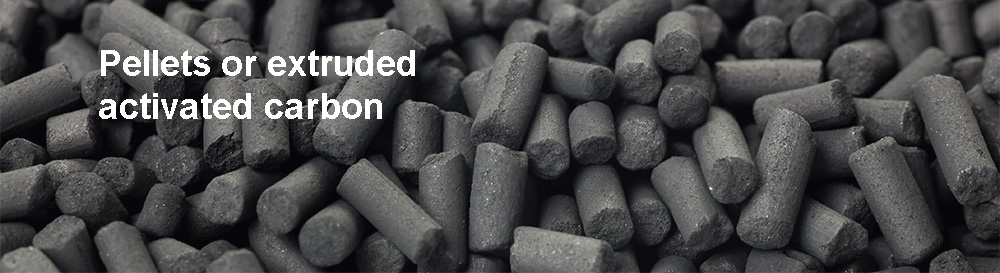
Extruded activated carbon (EAC)
-
It consists of small compressed cylinders.
-
Has high mechanical strength.
-
Widely used in the gas and aviation industries.
5. Comparison of production methods
| Street | temperature | To use | Shortage | Inquiry |
|---|---|---|---|---|
| physically | 700–1100 °C | Chemical-free and sustainable | High energy consumption and low porosity. | Gas cleaning and large-scale industry |
| chemical | 400–600 °C | High porosity and high efficiency. | Dry cleaning required | Water treatment, medicine, food industry. |
| Connection | Subject to change | Best quality and highest specialization. | higher costs | Advanced applications such as energy and nanotechnology |
6. Factors that influence the quality of activated carbon
-
Type of raw material : wood, coal or various types of agricultural waste.
-
Activator type : KOH creates smaller pores, while H₃PO₄ creates medium sized pores.
-
Curing time and temperature : Increasing the temperature generally increases the specific surface area, but if it is too high, it can lead to deterioration of the structure.
-
Heating speed : Effectively controls the pore size.
Cabot Safety Data Sheet – PLASBLAK-LL3608
7. Use of activated carbon
Activated carbon, which is obtained through various processes, is used in many industries depending on its properties:
-
Drinking water treatment : removal of odors, dyes and chemicals.
-
Air purification : Absorbs toxic gases and volatile organic compounds.
-
Food industry : sugar decolorization, beverage clarification.
-
Medicine : Used in kidney dialysis and treatment of poisoning.
-
Energy : Storage of hydrogen and methane for use in batteries and supercapacitors.
8. The future of activated carbon production methods
Today, with the growing interest in sustainable development , the focus is on the following approaches:
-
Use of agricultural waste and renewable raw materials.
-
Reduce energy consumption.
-
Does not pollute the environment.
Current research focuses on environmentally friendly activation using less energy-intensive methods and safer chemicals. Furthermore, new technologies such as nanotechnology and the production of activated carbon are opening up new perspectives in the energy and pharmaceutical sectors.
Finally
Activated carbon production falls into two main categories: physical and chemical . The choice of the appropriate method depends on the raw material, end use, and cost. Physical activation is simpler and more stable, while chemical activation creates a larger surface area and higher efficiency of the activated carbon. Combining both methods ensures optimal quality. Given the increasing demand for environmentally friendly materials, the production of activated carbon from renewable resources and using environmentally friendly methods offers promising prospects for the industry.